A little while ago two PhD students at work graduated from their respective Dutch universities. I had had a small hand in helping both of them with their theses -- mostly editing (thanks be to Brett), English and some thoughts on layout. I attended the graduation ceremonies of both and they are somewhat different to my own in Australia.
Firstly, the generic Australian version. Usually the protocol is to write the thesis, submit it to the univeristy who -- with the preparation of you and your supervisor who have invited them -- send it off to the examiners. There are rules about who can and cannot do this but in general it is three or four people who know enough about your work (hopefully) to say if it's rubbish or not. They prepare a report on the work and then recommend one of a few possible outcomes[1] This then goes to the University who generally follow through on the advice they have received and a bit later on you (optionally and usually a few months) head to the official graduation ceremony where you, along with a few hundred others (mostly undergraduates), are presented with your scroll of paper. At some universities they read out the thesis title of the graduand before handing over the parchment and other places -- like my own at ANU -- they just print it in the program.
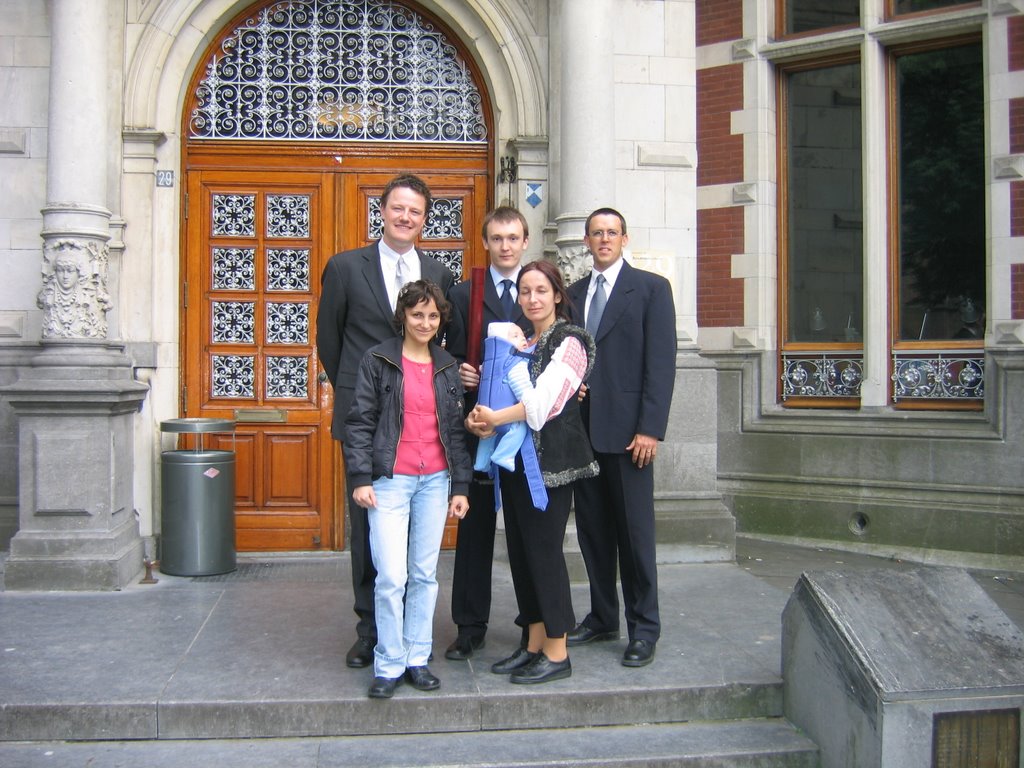
The differences with the Dutch system include, for starters, it takes more the form of a formal thesis defence. The candidate having previously published and submitted his thesis to the examining committee, then comes before them in a formal ceremony and is grilled for a designated -- and strictly controlled -- time period. Work colleagues, friends and family typically attend the ceremony. To support the grillee -- though pretty much only in a moral sense -- two assistants are asked and they are known as the paranimfs. I don't think there is an strictly equivalent word in English. Anyway, I was recently invited to be a paranimf. This pretty much involved wearing a dark suit, walking in the processions, standing in the right place at the right time and sitting still during the Process-O-Grilling. I thought it might also entail coming quickly to one's feet and calling 'Objection!' or stopping the candidate running from the room but I appear to have been mistaken. Overall the ceremony went well.
At the end of the Grill Fest the examining committee retires for its deliberations and upon return (usually) grant the degree on the spot. Usually then the candidate's "promotor" (the academic who officially is putting him forward as a candidate) says a few words about the candidate (now Doctor) and their efforts. The ceremony is concluded and friends, family and colleagues adjourn to a reception room to partake in drinks, hors d'œuvre, congratulations and possibly even some gift giving. Then it's all over bar the posing.
[1] Generally and broadly they are: conferral of degree with no changes, conferral of degree with minor changes, rewrite and resubmission of thesis and denial of degree.
All the Gruesome Details of the Life and Times of Fenton, Gaynor-Marie, Joshua, Elijah, Mara, Ariana, Bryna and now Micah.
Thursday, 5 October 2006
Tuesday, 19 September 2006
German Driver's Licence
This post is part vent, part information. So, the time has come for me to obtain my German driver's licence[1] and there are a number of rules governing the use of foreign licences here. For starters the most infuriating part is the sheer bureaucratic and almost arbitrary nature of which licences are easily exchangeable. Once you have moved here the rule is all licences should be converted to a German licence within 6 months. Since I only 'moved' here at the beginning of May[2] I must change over by November. There is a list as to which countries can simply exchange their licences and those whose resident's must take theory and/or practical tests. The list is generated using the rule: "Whoever Germany has made a formal agreement with". And that seems to be the only rule as far as I can find out.[3]
That means that all countries in the EU are fine to just exchange, since Germany as an EU member has agreed to this. The list gets a little stranger the further away you go. So Japan is free to exchange as are South Korea and Canada however Australia, New Zealand and South Africa are not. The list gets, in my opinion, positively crazy when some states in the U.S. can simply exchange -- such as Utah and Virginia -- others must only perform a theory test -- such as Missouri and Oregon -- and still others, such as poor Texas, must do both a theory and practical test. Australia, NZ and South Africa also fall into this category of having to do both tests. If you hold a current licence the requirement for a certain number of instructor hours is waived.
In addition to the tests one must also present documentation for a first aid course, eye sight test as well as a translation of any current licence. Of course each of these cost money and money also goes to pay for the tests, the licence itself and the driving lessons (enough for the instructor to determine that you are competent enough to pass). All up for Gaynor the cost was around the 400€ mark and I expect it will be a little cheaper for me, though probably not much. To keep this in 'perspective' one should realise that a first-time licence getter will pay a minimum of 1500€, most of which goes in lesson time to meet the required number of hours standard.
The craziest part of the licence exchange (fühererscheinumschreibung in German) is that legally it's ok for you to get off a plane from Australia -- having driven your whole life in a right-hand drive vehicle and on the left hand side of the road -- and do 200km/h down the autobahn. And you can keep doing this for 6 months not having a clue about the road rules or being able to read German to know them. After that however, they really view you as a danger on the roads since you don't have a valid licence!
On the plus side you do end up with pretty decent driver training and they really do seem to take their social responisibilty to be a good driver very seriously. In addition, the German driver's licences are valid for life. You only have to do this once and they never need to be renewed. And -- and here is the part I like and will miss soon enough -- you can keep driving on the autobahns. :D
[1] Gaynor's time has already come and gone and she successfully completed the transfer last April. But since she hasn't blogged about it, I'll have a go.
[2] Actually didn't blog about that piece of minor news though it was alluded to in our post about our visit to Amsterdam.
[3] Bit more information on driving in Germany at How To Germany.
That means that all countries in the EU are fine to just exchange, since Germany as an EU member has agreed to this. The list gets a little stranger the further away you go. So Japan is free to exchange as are South Korea and Canada however Australia, New Zealand and South Africa are not. The list gets, in my opinion, positively crazy when some states in the U.S. can simply exchange -- such as Utah and Virginia -- others must only perform a theory test -- such as Missouri and Oregon -- and still others, such as poor Texas, must do both a theory and practical test. Australia, NZ and South Africa also fall into this category of having to do both tests. If you hold a current licence the requirement for a certain number of instructor hours is waived.
In addition to the tests one must also present documentation for a first aid course, eye sight test as well as a translation of any current licence. Of course each of these cost money and money also goes to pay for the tests, the licence itself and the driving lessons (enough for the instructor to determine that you are competent enough to pass). All up for Gaynor the cost was around the 400€ mark and I expect it will be a little cheaper for me, though probably not much. To keep this in 'perspective' one should realise that a first-time licence getter will pay a minimum of 1500€, most of which goes in lesson time to meet the required number of hours standard.
The craziest part of the licence exchange (fühererscheinumschreibung in German) is that legally it's ok for you to get off a plane from Australia -- having driven your whole life in a right-hand drive vehicle and on the left hand side of the road -- and do 200km/h down the autobahn. And you can keep doing this for 6 months not having a clue about the road rules or being able to read German to know them. After that however, they really view you as a danger on the roads since you don't have a valid licence!
On the plus side you do end up with pretty decent driver training and they really do seem to take their social responisibilty to be a good driver very seriously. In addition, the German driver's licences are valid for life. You only have to do this once and they never need to be renewed. And -- and here is the part I like and will miss soon enough -- you can keep driving on the autobahns. :D
[1] Gaynor's time has already come and gone and she successfully completed the transfer last April. But since she hasn't blogged about it, I'll have a go.
[2] Actually didn't blog about that piece of minor news though it was alluded to in our post about our visit to Amsterdam.
[3] Bit more information on driving in Germany at How To Germany.
Monday, 21 August 2006
Sickness
We have had two sick people in the last week me and Ariana. I'm still sick so I get to stay home from school. It realy hurts. At scool I've got three new subjects History,physik and French. French is cool.
Elijah
Elijah
Thursday, 10 August 2006
Back to School
I remember in Australia the new school year was always a time of excitement and a little anxiety about whether the children would have the right teacher and the right friends in their class. Well this feeling is greatly exaggerated when the system and the language is unfamiliar (or barely familiar). To further compound this feeling, Mara started high school today and she is not yet 10. She seems so small to start high school though in other regards she is well equipped as she is fluent in German, is quite studious and very determined. Still, I don't like the idea of her travelling home alone a couple of days a week.
One off the joys of the system is that children finish at different times so lunch can last 2 hours. In addition the first child home will have finished all their homework, jobs and piano practice before the last child is home. This means they are asking for screen time before the others have even had lunch (for me this is a logistical nightmare).
A little whinge: The parents must supply all the equipment but unlike the book packs you can buy in Australia the primary school gives you a comprehensive list down to colours and sizes etc, that you normally can find everything by visiting 2 shops. The high school doesn't manage to form a list instead requests trickle home via the children over the next couple of weeks, but normally with the plea that I must have it tomorrow (fat chance) we don't know whether the urgency comes from the teacher or the children only telling us at the last minute. This is also difficult to budget for and by the end of the period I'm loathe to hand over any more money. End of whinge.
Joshua is in year 7 and will be learning Latin this year which he is very excited about. Elijah has the same teachers as last year which is a bit of a concern. His German teacher is antiquated and his English teacher said that nothing is more important than school work. Elijah replied that family, church and sport were more important than school (and we mostly agree with him -- which is not very German of us).
Ariana is in the 2nd grade and has the same teacher as last year who is very nice. Ari is really good at math but, we must help her with reading English and German. She sounds out everything but has no fluency or much comprehension yet. I think it will all come together soon.
Bryna started Kindergarten -- or as she calls it "garten schule" (garden school) -- this morning and she looked so little with her "princess" backpack on her back. When I asked her what made her backpack heavy she replied "Essens" (which is an English plural of the German for food. Good Denglish!). She didn't want me to stay (she doesn't need me any more :( -- pass the TimTams) and she was very quite when I picked her up. So I asked her how it was and she answered "spass gehabt" (had fun). This evening Mara said "I have maths tomorrow" and Bryna replied "I have garden maths tomorrow". I asked, "What do you do in garden maths?" and she answered "Count blatte" (leaves).
I hope the children have a good school year. I am looking forward with a little trepidation to mornings all alone, as this will be an experience I haven't had for 13 years. I have a list 1.6 km long of what I hope to achieve in my 3 hours a day. :D
One off the joys of the system is that children finish at different times so lunch can last 2 hours. In addition the first child home will have finished all their homework, jobs and piano practice before the last child is home. This means they are asking for screen time before the others have even had lunch (for me this is a logistical nightmare).
A little whinge: The parents must supply all the equipment but unlike the book packs you can buy in Australia the primary school gives you a comprehensive list down to colours and sizes etc, that you normally can find everything by visiting 2 shops. The high school doesn't manage to form a list instead requests trickle home via the children over the next couple of weeks, but normally with the plea that I must have it tomorrow (fat chance) we don't know whether the urgency comes from the teacher or the children only telling us at the last minute. This is also difficult to budget for and by the end of the period I'm loathe to hand over any more money. End of whinge.
Joshua is in year 7 and will be learning Latin this year which he is very excited about. Elijah has the same teachers as last year which is a bit of a concern. His German teacher is antiquated and his English teacher said that nothing is more important than school work. Elijah replied that family, church and sport were more important than school (and we mostly agree with him -- which is not very German of us).
Ariana is in the 2nd grade and has the same teacher as last year who is very nice. Ari is really good at math but, we must help her with reading English and German. She sounds out everything but has no fluency or much comprehension yet. I think it will all come together soon.
Bryna started Kindergarten -- or as she calls it "garten schule" (garden school) -- this morning and she looked so little with her "princess" backpack on her back. When I asked her what made her backpack heavy she replied "Essens" (which is an English plural of the German for food. Good Denglish!). She didn't want me to stay (she doesn't need me any more :( -- pass the TimTams) and she was very quite when I picked her up. So I asked her how it was and she answered "spass gehabt" (had fun). This evening Mara said "I have maths tomorrow" and Bryna replied "I have garden maths tomorrow". I asked, "What do you do in garden maths?" and she answered "Count blatte" (leaves).
I hope the children have a good school year. I am looking forward with a little trepidation to mornings all alone, as this will be an experience I haven't had for 13 years. I have a list 1.6 km long of what I hope to achieve in my 3 hours a day. :D
Friday, 4 August 2006
Broadband Comes to Town
Even though I knew the village we were shifting to was small I thought that broadband internet access was available everywhere in Germany. Unfortunately that wasn't true and even the largest company (Deutsche Telekom or T-Online, T-Mobile etc) had few options[1]. All I wanted was something that meant the phone could be used at the same time and had no time limit. All phone calls are timed in Germany and so there is no such thing (that I have come across) as a dial-up internet 'plan'[2].
Anyway I was all set to sign up for a UMTS internet account (UMTS is basically internet via 3G mobile telephony) when a flyer arrived in the mailbox announcing a small company who were offering a phone and DSL package to our village. Yaaay! I called them a few days later and, after a couple of questions, signed up. So we are now humming along with relatively fast access at home.
This all means that I think the world can now expect a bit more of a digital presence from Gaynor and the children (especially Elijah!) and possibly even some more frequent blog posts.
[1] Among them, ISDN (only a little faster than a dial-up modem) and Satellite 'DSL'( which receives via satellite and uploads via modem or ISDN).
[2] You just dial up a company, use a publicly available login & password and you pay from there with the requested payment coming with your T-Com bill.
Anyway I was all set to sign up for a UMTS internet account (UMTS is basically internet via 3G mobile telephony) when a flyer arrived in the mailbox announcing a small company who were offering a phone and DSL package to our village. Yaaay! I called them a few days later and, after a couple of questions, signed up. So we are now humming along with relatively fast access at home.
This all means that I think the world can now expect a bit more of a digital presence from Gaynor and the children (especially Elijah!) and possibly even some more frequent blog posts.
[1] Among them, ISDN (only a little faster than a dial-up modem) and Satellite 'DSL'( which receives via satellite and uploads via modem or ISDN).
[2] You just dial up a company, use a publicly available login & password and you pay from there with the requested payment coming with your T-Com bill.
Subscribe to:
Posts (Atom)